There Formula 1 it is many things: entertainment, technology, progress, rivalry between men, colour, fashion, passion. Today the show seems to have the upper hand, obscuring the other elements that have made this discipline a universal phenomenon, almost as if the rest were an obstacle to the commercial progression that is the basis of the audience.
But F.1, like motor racing in general, is first and foremost an extended culture that opens the doors to other cultures of everyday life. The Turin Automobile Museum has been able to interpret precisely this philosophy to the point of being a sophisticated point of reference for artistic trends in which the car is often not necessarily the protagonist, while remaining evocative of the context. A visit is a fascinating and surprising journey that from April 2nd to October 1st offers a precious opportunity to immerse yourself in what F.1 really represents, or has represented, for all of us and, also, for the evolution of the motoring world.
This time we’re not talking about Ferrari but about the Cavallino’s enemies, more precisely <<The enemies of the Drake, Enzo Ferrari and the English stables>>. A review of 22 single-seaters conceived across the Channel by those who the Grand Old Man defined as <<garage owners>>, despite knowing very well that those garage owners expressed genius and astonishing contents to which he himself frequently had to adapt. In a space of two thousand square metres, what England represented in racing and cultural influences on the world comes to life with the Swinging London revolution.
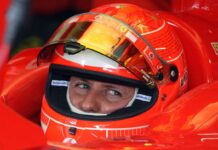
I of F.1 came mostly from the British aeronautical industry, which was very flourishing at the time of the Second World War and the lack – at that time – of prosperous budgets they made up for with ingenuity and limitless imagination, granted by very open regulations. And here’s the rear engine, the aerodynamics, the miniskirts, the ground effect, the turbine-powered Lotus which also ran in Monza, romantic Anglo-Modena combinations like the Cooper Maserati. A golden period that begins from Ferrari (could it be missing?) which with Mike Hawthorn concludes the front engine era and arrives at Barnard’s F.1-89, the one with the electrically operated gearbox on the steering wheel, designed in Guildford. A fascinating journey conceived and created with intelligence and culture by Carlo Cavicchi and Mario Donnini with the collaboration of Maurizio Cilli, in which there is then a review of the helmets of famous pilots which goes hand in hand with the safety path, there are the programs of the races of the past, there is a splendid photography exhibition by Rainer Schlegelmilchmore details and various curiosities. At the book shop there is the book-catalogue of the exhibition, another gem not to be missed. It is then worth an excursion to the upper floor, for the fabulous display of Italian-trained designers, modern Ferraris and Sparco racing suits. After the visit you will look at the grand prix differently: do you think that’s not enough?