





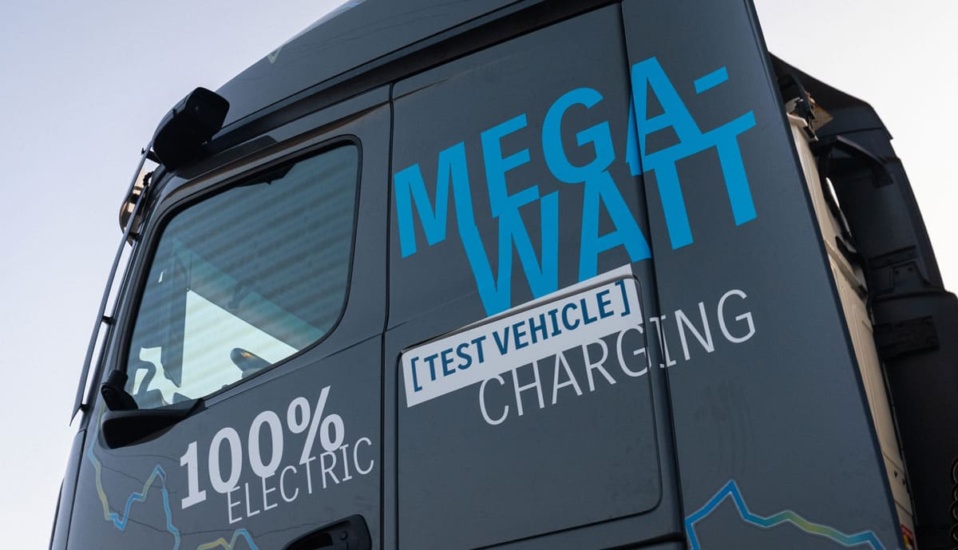
At the beginning of the year, development engineers from Mercedes-Benz Trucks carried out a long-distance test drive with two eActros 600 test trucks to test charging with the new Megawatt Charging System (MCS) standard. The aim of the test drive was to evaluate the compatibility between vehicles and megawatt charging stations from various manufacturers and to obtain information about the feasibility of charging in winter conditions.
The test drive covered a distance of approximately 2,400 kilometers from Germany via the Netherlands, Belgium and Denmark to Sweden. Along the test route, electric vehicles were charged at both public and private MCS points designed specifically for trucks. Following the tests, one of the two eActros 600s with MCS made a detour to the Finnish Arctic Circle and then returned south to undergo additional winter testing in temperatures as low as -20°C.
Peter Ziegler, Head of E-Charging Components at Mercedes-Benz Trucks, explains the findings and explains the next steps. According to the executive’s statement, test drives and winter tests related to the MCS standard have provided important information about the megawatt charging standard, especially on battery thermal management and interoperability between the vehicle and the charging infrastructure.
“Megawatt charging possible even at low temperatures”
“Research has confirmed that charging capacities in the megawatt range are possible even at low temperatures, especially if the battery has a sufficiently high operating temperature,” Ziegler said. “This requirement is met in real-world use, as we assume that megawatt charging in practice usually takes place during the legally mandated driving break after the driving cycle. At the same time, successful charging operations were carried out at various charging points during test drives, demonstrating the basic suitability of the system for practical application.”
Mercedes-Benz Trucks sees megawatt charging as a key element for the global electrification of heavy-duty long-distance transport and supports the MCS standard as an open, cross-manufacturer solution. Given the dynamic global market development for battery electric commercial vehicles, a uniform, internationally compatible charging standard is becoming increasingly important. For the commercial vehicle brand, MCS lays the foundation for interoperability, scalability and investment security across markets and manufacturers.
According to Ziegler, the finalization of the ongoing MCS standard covers not only the hardware and software of the vehicles, but also the hardware and software of the charging infrastructure. “In the coming months, we will carry out further interoperability tests with various charging station manufacturers to further improve the interaction between the vehicle and the charging infrastructure and to be able to offer our customers the best possible overall charging station and vehicle system in the future.” to this
In parallel, Daimler Truck is involved as an industry partner in the “High-Performance Charging in Long-Distance Transport” project and will contribute the eActros 600 to real-world tests of the high-performance charging infrastructure later this year. In the second half of the year, the company eActros 600s with MCS will begin initial customer trials in real-world logistics operations. The vehicles will be deployed at various customer locations within the scope of the “Electrification of Inbound Logistics” project, which aims to electrify the transportation logistics of German Mercedes-Benz Trucks production facilities. In order to enable faster charging of electric trucks, an MCS-compatible charging station is planned to be installed at the factory premises in Wörth am Rhein from the middle of the year.
Automobile Magazine – Germany
Automobile Magazine – English