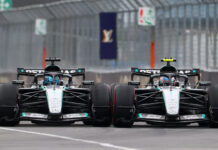
Formula 1 reaches the second qualifying of the season, valid for the Sprint of the Chinese Grand Prix, and finds a scenario in some respects not too dissimilar to what was seen on the opening weekend in Australia: Mercedes ahead with over half a second ahead of the first of the pursuers and a Ferrari in difficulty especially on the flying lap. This time, however, McLaren is entering the fight, which already appears to have improved compared to Melbourne in numerous respects, both in terms of engines and set-up. Russell and Antonelli still take the entire front row almost walking, but looking at the data in detail a particular aspect emerges which encompasses much of the large gap shown by the stopwatch.
The data of the tour: a continuous yo-yo for two sectors
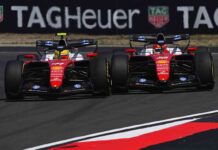
The first premise of the day is that rarely like this weekend are we experiencing very low quality of the telemetry data transmitted by the FOM, with continuous interruptions of the signals from the control units of the various cars and noise in the data that we struggle to filter out despite having implemented more than one algorithm. In any case, looking at the data, it is still clear enough what happens on the track. Since the debut of the lap, George Russell’s Mercedes has been the fastest in the first sprint, immediately taking the first lead. However, the two Ferraris and Norris’ McLaren do battle in the corners and take advantage of Russell’s first lift and coast at the entrance to turn 6 to remain chronometrically locked to the train of the number 63. The “interesting” things begin in the second sector: in the sprint that passes through the very fast turn 7 Leclerc and Hamilton have to leave 7-8 km/h of speed due to lack of energy, while both Russell and Norris can make full use of the Power Unit. Despite this, in the progressive slowdown of turn 8, then towards turn 9-10, the two Ferrari drivers prevailed, limiting the gap to no more than two tenths. The gap line is unfortunately approximate given the low quality of the data, but we learned from the Shanghai paddock that beyond the specific values the trends are correct.
The great harvesting and then Russell’s “mysterious” super clipping
Arriving at turn 11 we notice a huge phase of energy collection by Russell, who does not lift his foot from the accelerator but loses 16 km/h in a straight of just 6 seconds, doing a first phase of the so-called super clipping before the complicated main straight. Neither the McLaren of Norris nor the two Ferraris of Hamilton and Leclerc show similar signs, in fact as far as the red cars from Maranello are concerned we notice the opposite strategy, with a significant discharge of electrical energy in the short sprint and particularly high top speeds, evidently with the underlying thought of being able to recover the energy necessary for the following demanding stretch through the important braking at turns 11 and 12. This high-energy stretch of the Ferraris and Norris almost eliminates the gap from Russell, with the four appearing with times all within a couple of tenths on the very long back straight. And here, after a very similar first phase, the super clipping mode begins in which the combustion engine is also used to recharge the electrical part. We immediately see that Leclerc has some serious problems with energy deployment, leaving 15 km/h to Russell and in any case 10 to his teammate, and ending up cut out of any game immediately. Unfortunately for both Russell’s Mercedes and Norris’s McLaren the data flow is interrupted right at the entrance to the super clipping phase (we wonder if the electromagnetic interference at the maximum charging phase ruins the signal from the control units), but the confirmation we have received is that precisely in this phase Russell opens the gap to all the pursuers. Therefore, of the six tenths that we see at the finish line over the first of the pursuers, at least 3-4 come from the different exploitation by Russell and the Mercedes of the clipping and super clipping phase.
The feeling: a longer blanket combined with a unique strategy
Seeing these data, there are essentially two considerations that come to mind. On the one hand, it seems clear that Mercedes has a surplus of energy to manage compared to the competition. A long blanket that you can spread where it matters most. It is no coincidence that in the yoyo seen during the lap, Mercedes arrives at the entrance to the last straight on par with the others but with, evidently, much more energy to expend. The second is that for Mercedes everything is carefully calibrated (as it should be) to maximize the profit from this situation. A longer and more effective supply of energy precisely in the section where the other single-seaters are in greatest difficulty means a potentially enormous chronometric advantage, which is what we then find on the finish line. It also seems clear, however, that the knowledge of this very particular superclipping method, for which we hope to finally have the data to analyze tomorrow, is precluded to the customer teams, with McLaren, for example, which seems to discover session after session how the drive unit produced in Brixworth can be exploited.
Tires, load and… Party Mode
In all this, little is said about tyres, loading and settings and, to close, here are my impressions in this sense. Ferrari continues to prove fast in all the corners where the chassis is important. The aerodynamic load seems absolutely on par with its rivals and, after a free practice session with some difficulties, the single-seater seemed at ease on the track, with Hamilton even showing great confidence at the last corner, the fast section which saw him leave dozens of km/h to the competition due to his lack of confidence with the single-seater. McLaren seemed to have improved a lot in terms of set-up, even if not with the level of load generated by the Ferrari, but with the possibility of exploiting the torque of the Mercedes drive unit in traction, which guarantees a certain tranquility. All these differences appear maximized on the flying lap, confirming the impression of a return of the so-called Party Mode for Mercedes-powered cars. We will see what will happen in the Sprint starting from the start and if we will finally be able to have a clean and complete data signal to analyze.