



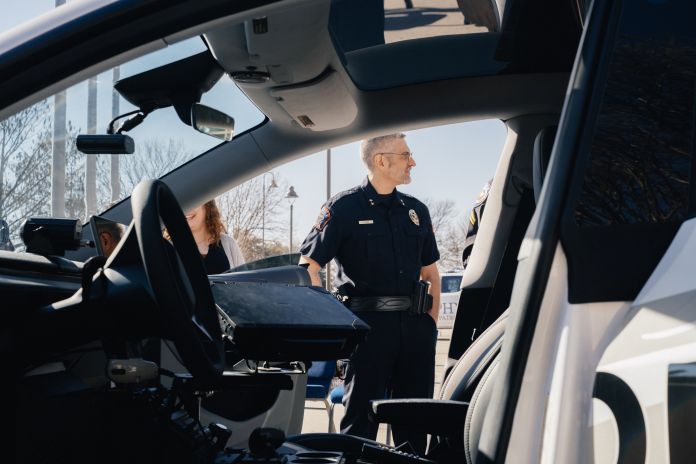
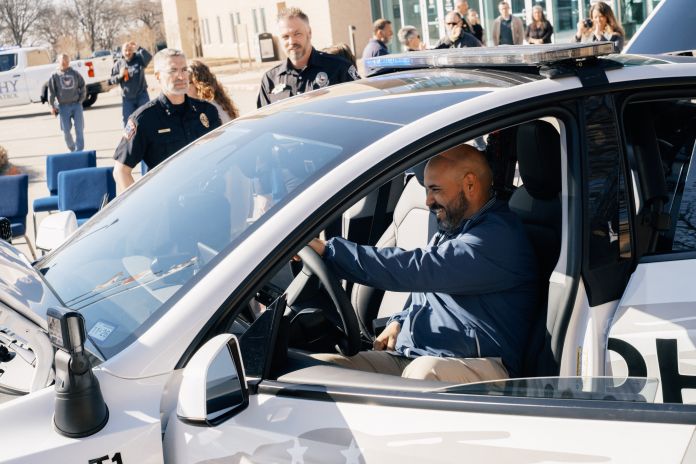
The Murphy Police Department, in partnership with UP.FIT, a division of Unplugged Performance, unveiled two 2026 UP.FIT Tesla Model Y Juniper patrol vehicles at a public ceremony attended by city leadership, officers, and community members. Murphy is among the first law enforcement agencies to deploy the Tesla Model Y Juniper in active patrol service, reflecting the city’s commitment to officer safety, fiscal responsibility, and forward-thinking governance.
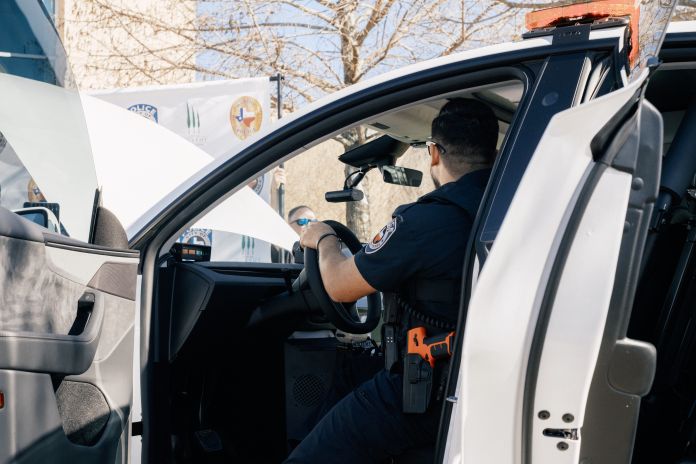
“Today represents history and a very exciting day in the City of Murphy and the Murphy Police Department,” said Chief Jeff Gibson, who leads the department. “The police department was tasked with evaluating and developing a creative and innovative approach to the rising cost of vehicle operations, maintenance, and fuel, while adopting an environmentally conscious model that sets a blueprint for the future. We are proud to present an electric vehicle option that delivers cost reductions in maintenance and fuel while being a partner in going green.”
Officer Safety Comes First
At the core of UP.FIT’s mission is a simple conviction: first responders deserve to patrol in vehicles that offer the very best crash safety available. The Tesla Model Y has earned top safety marks from the National Highway Traffic Safety Administration (NHTSA) and other global safety agencies, providing officers with an unmatched level of occupant protection during the inherent hazards of patrol duty. By building on this safety foundation, UP.FIT patrol vehicles give agencies confidence that the men and women serving their communities are protected by the most advanced vehicle safety engineering on the road today.
Projected Operational Savings That Fund Other Priorities
The financial case for UP.FIT patrol vehicles is compelling. When assigned to a single officer patrolling approximately 42 hours per week, each UP.FIT Model Y is projected to capture $4,100 to $7,600 per year in operational savings compared to traditional gasoline patrol vehicles. In shared-vehicle scenarios logging 140 to 168 patrol hours per week, those savings grow to a projected $8,500 to $12,000 per vehicle per year.
City Manager Aretha Adams underscored the financial significance during the unveiling: “When you look beyond the initial purchase price and consider fuel, maintenance, and long-term operating costs, these vehicles actually present a lower total cost than what we’re currently using in our fleet. This initiative reflects our commitment to making smart financial decisions—decisions that stretch our taxpayers’ dollars further while maintaining the same high standard of service.”
Those savings represent dollars no longer burned up in gasoline out of a tailpipe—dollars that can be redirected to fund additional officers, equipment, training, community programs, and other department priorities.
Built to Last: Twice the Fleet Life of Gasoline Patrol Vehicles
Legacy gasoline police vehicles face a well-documented durability problem. The extreme demands of patrol duty—particularly the extensive engine idling required to power radios, laptops, and other critical onboard electronics—accelerate wear and drive costly maintenance issues that can become existential at high mileage and engine-hour accumulation. As a result, traditional patrol vehicles often reach the end of their useful fleet life well before agencies would prefer.
UP.FIT Model Y patrol vehicles are expected to last approximately twice as long in the fleet as their gasoline counterparts—and potentially even longer. Electric drivetrains eliminate the idling wear that shortens the lifespan of internal combustion patrol vehicles, and the simplified mechanical architecture means fewer components subject to failure under demanding duty cycles. This durability translates directly to less frequent replacement vehicle budgeting and a significantly lower amortized cost of operation per year, compounding the savings already realized through reduced fuel and maintenance expenses.
Responsible Innovation, Backed by Real-World Evaluation
“This is not a statement. It’s not a trend,” Adams emphasized. “This is part of our responsibility to continuously evaluate how we serve our community in the most effective and fiscally sound way possible. These two vehicles will allow us to evaluate performance in real-world conditions—how they operate during a full patrol shift, how they integrate with our existing infrastructure and equipment, and how they perform in our climate and response patterns. If the data supports expansion, we will consider it. If adjustments are needed, I am committed to making them. That is what responsive governance looks like.”
Murphy’s public safety fleet has traditionally relied on large gas-powered SUVs that require significant maintenance and fuel expenditures over time. By incorporating UP.FIT electric patrol vehicles, the city is taking a deliberate, data-driven step toward cleaner operations, reduced fuel consumption, and a lower overall carbon footprint—while maintaining the operational readiness that public safety demands.
A Collaborative Partnership
The Murphy deployment utilized Enterprise Fleet Management for financing and fleet vehicle maintenance while UP.FIT handled engineering and upfitting the 2026 Tesla Model Y Juniper vehicles into fully patrol-ready platforms. Chief Gibson credited the partnership and the dedication of Murphy’s officers and the city manager for making this first deployment a reality.
“I want to thank the fantastic men and women of the Murphy Police Department who put in countless hours of dedication and commitment for you to see and touch what you see today,” Gibson said. “Absent them, we would not be here. When we talk about relationships, they hold value and they have purpose and they have meaning. That is one of the best benefits of the City of Murphy—we recognize we are a collaborative community and we work together for exceptional service models and success.”
Adams added: “I want to thank our residents. This initiative reflects what you expect from us—strong public safety, smart financial management, and responsible environmental stewardship. These vehicles will serve the same purpose as the ones before them: to keep our community safe. They simply allow us to do it more sustainably and more cost-effectively.”