





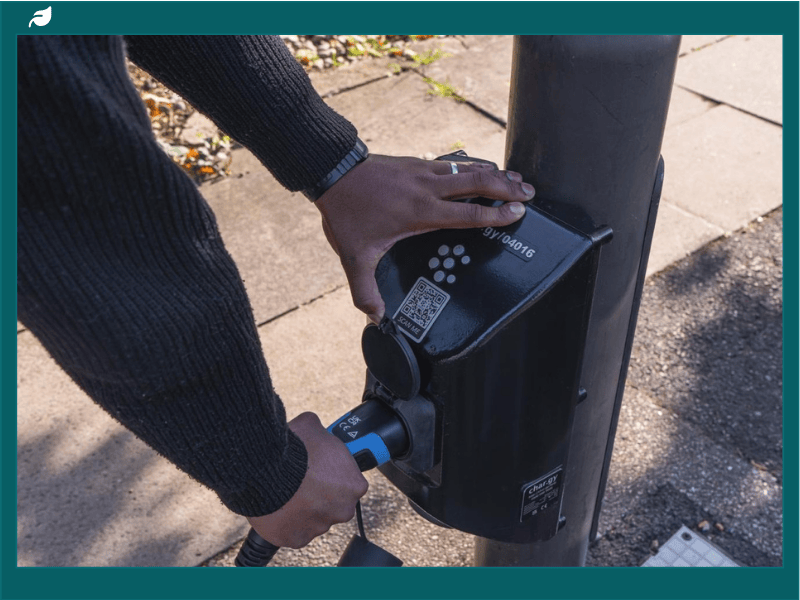
The London Borough of Harrow is installing 500 new on-street electric vehicle charge points in partnership with char.gy, expanding access to residential charging across the borough. The rollout is focused on streets where residents do not have access to a driveway or off-street parking.
A total of 225 charge points have already been installed, with a further 275 due to be in place by 2 October 2028. The new infrastructure is designed to support drivers who rely on on-street parking, offering low-powered charging suitable for overnight top-ups while vehicles are parked at home.
The charge points are attached to existing lamp columns, using street infrastructure to deliver neighbourhood-based charging. This approach is increasingly being adopted by local authorities seeking to provide practical charging options in densely populated urban areas where private home charging is not possible.
Cllr David Ashton, Cabinet Member for Finance and Highways, said: “We’re putting residents first by making it easier to charge electric vehicles where people actually live. More on-street charging means less time searching for a plug and more confidence for drivers every day. It’s a big step forward for residents who already drive electric and for anyone thinking about making the switch.”
All new charge points operate on 100% renewable electricity. Charging tariffs include clear pricing structures and lower overnight rates, reflecting typical residential charging patterns and supporting drivers who charge their vehicles during off-peak hours.
John Lewis, CEO of char.gy, said: “We’re delighted to be expanding our network in Harrow with 500 new charge points. This expansion will make a real difference for everyday drivers: people who live without a driveway, those switching to electric for the first time, and anyone who wants reliable, affordable charging close to home. Providing local charging that people can depend on gives drivers confidence to switch to electric, and that’s what this rollout is all about. We look forward to working with the council, residents and local communities as these chargers go live.”
The expansion forms part of Harrow’s wider climate strategy and builds on existing investment in electric vehicle infrastructure. More than 100 on-street chargers are already operational in the borough through partnerships supported by government funding, including the On-Street Residential Chargepoint Scheme (ORCS).
ORCS was established to help local authorities increase the availability of on-street charging for residents without off-street parking. By combining local authority leadership with central government backing and private sector delivery, schemes such as this aim to remove one of the practical barriers to electric vehicle adoption in urban areas.
Transport remains one of the largest sources of carbon emissions in the UK, with passenger cars accounting for a significant share. Expanding convenient access to charging infrastructure is seen as a key enabler of the transition to electric vehicles, particularly in London boroughs where terraced housing and high-density streets limit private charging options.
Lamp column charging provides a lower power alternative to rapid or ultra-rapid hubs. While not designed for quick top-ups on the move, these chargers are intended to serve residents who park overnight, allowing vehicles to charge gradually over several hours. This model supports steady demand on the local electricity network and aligns with typical household parking patterns.
The borough’s approach reflects a wider shift toward distributed, neighbourhood-level infrastructure that integrates with existing streetscapes. By using lamp columns, installation can be less disruptive than standalone charging posts and can make use of established grid connections.
A short video demonstrating char.gy’s lamp column charge points in use in Harrow has been made available to show how the system works in practice.
As the remaining 275 charge points are delivered over the coming years, Harrow’s network will offer residents a broader choice of charging locations close to home. The council says the expanded provision is intended to provide convenient and reliable access to charging across the borough, supporting cleaner journeys and increased confidence among current and prospective electric vehicle drivers.