





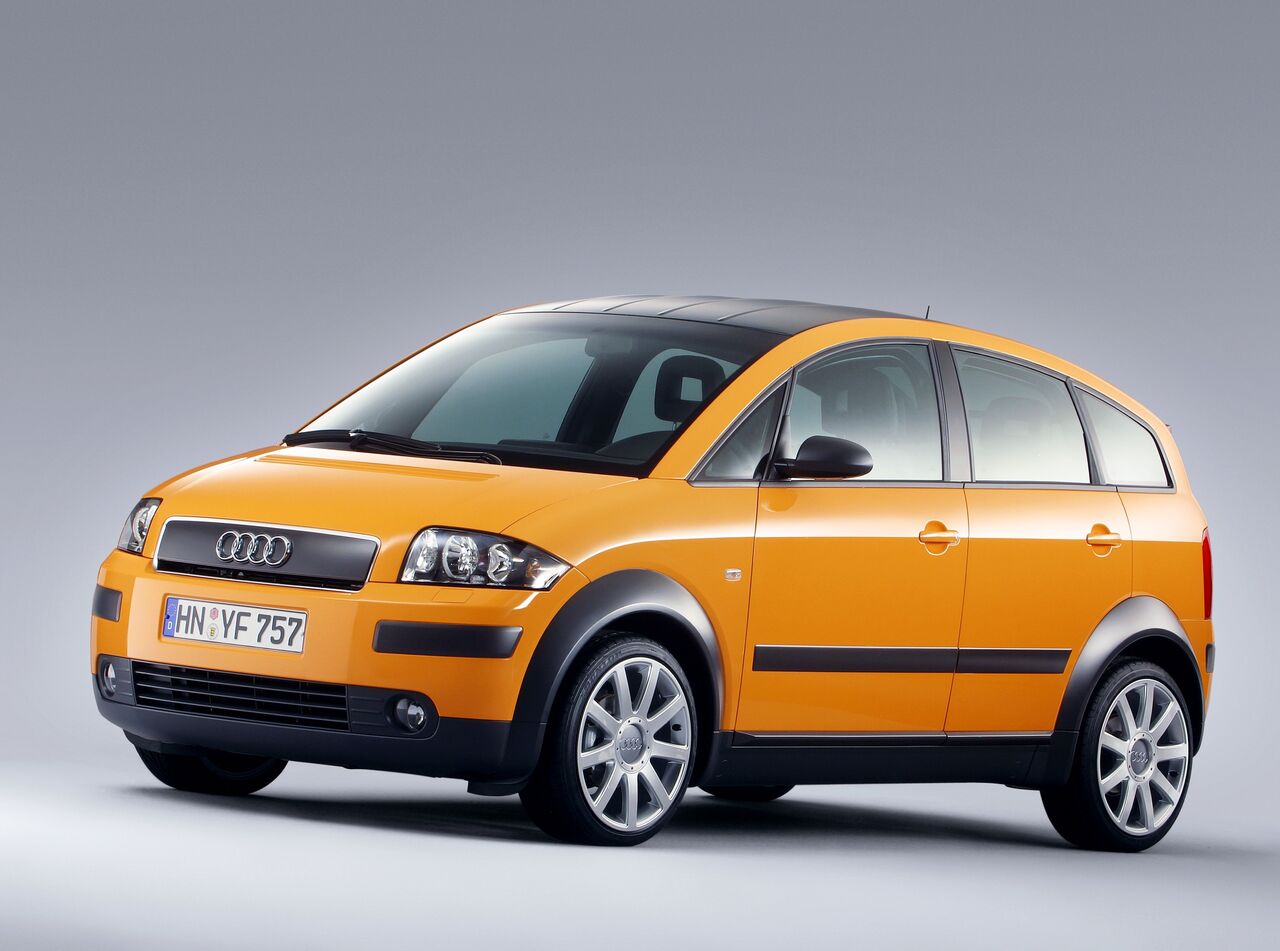
In the early 1990s, the three-liter car was announced as a development goal by the Volkswagen Group and Audi, and the first work on the project began shortly afterwards. The designers in Ingolstadt worked closely with the experts at the aluminum center in Neckarsulm. In May 1995, they presented a concept study called “Ringo,” whose Audi Space Frame (ASF) was less complex than the ASF of the Audi A8, which was largely built by hand. Stefan Sielaff – the former head of Audi’s Munich design studio – took over the project and led the interior design, while Belgian designer Luc Donckerwolke handled the exterior. Together with future design chief Gerhard Pfefferle, they gave the “rolling cage” Ringo a two-door body – which proved already close to the later design. As development progressed, two studies were created: one was a show car at the IAA in Frankfurt in 1997 and, in addition to the provisional model designation Al2, it bore the nickname “Light Green” because of its color. Only a little later, “Light Blue” could be seen at the Tokyo Motor Show, a three-door variant of the Al2 with a variable loading area and retractable sunroof. Its name: Audi Al2 open end.The public reacted to the two studies differently. Some people were enthusiastic about the progressive design; others didn’t like it. The developers had certainly expected that their results would polarize opinions, recalls Al2 project manager Harald Wester 20 years later in an interview with Dirk-Michael Conradt, author of Audi A2 – Meilenstein und Kultobjekt [“Audi A2 – Milestone and Cult Object”]. Wester says in the book: “Yes – it was clear to all of us from the beginning! The car had to be optimally streamlined. We practically slept in the wind tunnel to achieve optimal aerodynamics.” In November 1997, the Board of Management approved series production. The world premiere of the Audi A2 was to take place again at the IAA – just two years later. The plan was ambitious, but the designers and engineers were able to keep to the schedule.At the IAA in September 1999, the A2, which had been developed for series production, was presented to the world – it was the first compact car in recent automotive history whose body was made entirely of aluminum. The body shell of the A2, including all four doors and the tailgate, weighed only around 153 kilograms, which was only about 60 percent of the body shell weight of a comparable sedan with a conventional steel body. The 3.83-meter-long, 1.67-meter-wide, and 1.55-meter-high Audi A2, which offered plenty of space for its passengers despite its small exterior dimensions, was produced in Neckarsulm. New production facilities were built there especially for the A2 and inaugurated on November 15, 1999. On that day, Audi also presented the A2 1.2 TDI, the world’s first four-door three-liter car. A total of two gasoline and three diesel engines were available over the production lifetime of the Audi A2. The two gasoline models were powered by a inline four-cylinder engine and were available with a five-speed manual transmission and front-wheel drive. The combined fuel consumption was 5.9 liters per 100 kilometers. The A2 models with diesel engines had three-cylinder units with pump-nozzle direct injection. For the market launch on June 30, 2000, a gasoline engine and a TDI, each with an output of 75hp, were available. (Note to editors: The production statistics for the Audi A2 can be found at the end of this MediaInfo).In the spotlight: the A2 1.2 TDI with a sensational drag coefficient of 0.25The Audi A2 1.2 TDI, which was introduced at the end of 1999, went on sale in March 2001. It delivered 61hp and required only 2.99 liters of diesel per 100 kilometers. Its direct-injection turbodiesel engine was made entirely of aluminum. In the five-speed automatic transmission, an electrohydraulic system took over the clutch function. The use of additional vehicle parts made of aluminum, special aluminum forged lightweight wheels, and weight-optimized rear seats made it possible to reduce the weight by 135 kilograms compared to the basic version – to a curb weight of 855 kilograms. In order to further optimize aerodynamics, the cool-air intakes in the front were partially closed, and the tires made narrower and flow-optimized thanks to grooves in the sidewalls. Adapted wheel arch trims and wheel covers as well as additional underbody paneling enabled turbulence-free airflow. By doing so, the engineers were able to reduce the drag coefficient from an already very good 0.28 for the base model to a sensational value of 0.25.In 2002, Audi added a 1.6-liter FSI engine to the A2 engine range. Its 110hp allowed the A2 to reach a top speed of more than 200 km/h. Starting in March 2003, the brand with the four rings offered the Audi A2 in a special edition called “colour.storm” – in the colors Imola yellow, Misano red pearl effect, Sprint blue pearl effect, and Papaya orange. Color-coordinated interiors and matt-black painted details, such as roof and wheel arch trims, created a striking contrast. The models could be combined with numerous optional extras as well as with four of the five engine variants – not the 1.2 TDI. By July 2005, a total of 176,377 units of the Audi A2 had been built at the Neckarsulm site. The premium compact vehicle couldn’t meet the high expectations originally set for it. Around a quarter of a century later, however, the small space miracle still has numerous fans – many drivers still appreciate their A2 as an economical, reliable, and attractive companion for their everyday life.Models and deliveries of the Audi A2 at a glance Engine Model designation Production period Units built 1.2-liter TDI 45 kW / 61 PS Audi A2 1.2 TDI 2000–2005 6,555 1.4-liter 55 kW / 75 PS Audi A2 1.4 2000–2005 81,649 1.4-liter TDI 55 kW / 75 PS Audi A2 1.4 TDI 2000–2005 69,676 1.4-liter TDI 66 kW / 90 PS Audi A2 1.4 TDI 2001–2005 7,416 1.6-liter FSI 81 kW / 110 PS Audi A2 1.6 2002–2005 11,081 Total 176,377 If you want to delve deeper into the history of the Audi A2, we recommend the book by Dirk-Michael Conradt Audi A2 – Meilenstein und Kultobjekt [“Audi A2 – Milestone and Cult Object”], Audi Tradition Edition, Delius Klasing Verlag, ISBN no. 978-3-667-11398-6. The book [published in German] is available for 39.90 euros in the Audi Tradition Shop at the Audi Forum Neckarsulm, in the museum store of the Audi museum mobile in Ingolstadt, in bookstores, and from the Audi Tradition online shop.
AU