





The Opel team first identified possible usage scenarios to show what the vehicles of the future can do. These, “possible danger from a pedestrian or other situation” and “where the situation becomes safe and the danger from the pedestrian disappears” were scenarios. In simple words, these scenarios represented situations that most drivers may encounter in daily life. For example, a child running the ball onto the road or a pedestrian suddenly appearing between two parked vehicles. Taking these situations into consideration, the team equipped the Grandland test vehicle with both a camera system that can detect objects and movements and artificial intelligence support. An algorithm that can predict intentions integrated. Then, he began to develop lighting technologies that would support these systems.
Grandland, SAE When operating in Level 3 or above mode, it sends a clear signal to other road users by constantly glowing its front and rear indicators in cyan. Meanwhile, the other signature lighting remains in its usual white colour. When the camera systems detect a pedestrian in front of the vehicle, the signature lighting turns magenta and the screen shows a warning signal in the same color. Thus, the pedestrian visually notices that the vehicle is approaching and the vehicle begins to slow down. After Grandland stops, the signature lighting turns green and the “walking green figure” seen in pedestrian crossing lights appears on the screen. This shows that the vehicle has noticed the danger, stopped and the pedestrian can now pass safely. In cases where the situation cannot be managed by the artificial intelligence algorithm, the system warns the driver to take control of the vehicle. This structure Sectoral information regarding ADAS protocols It is also fully compatible with standards.
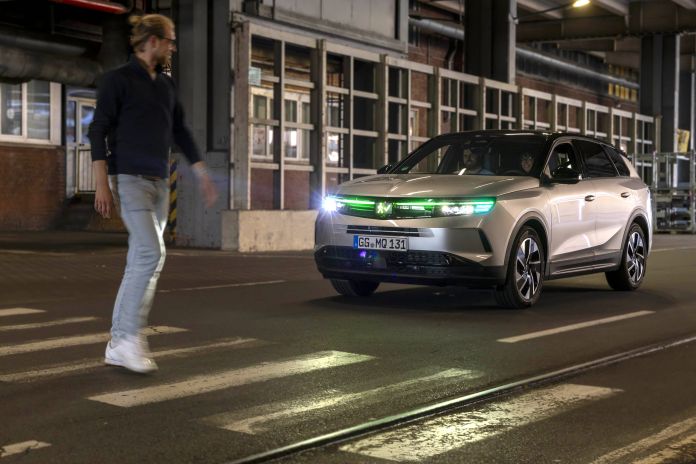
Stellantis Innovation Engineering Director Julisa Lesaid: “To avoid misunderstandings, we specifically chose colors that are not associated with other vehicle functions. For example, red, although intuitively a warning color, is used in stop lights and taillights. Cyan and magenta colors have been carefully evaluated for perception and are not used in any traffic situation today. Both colors provide clear and understandable communication with other road users.”
This innovation reflects Opel’s commitment to developing accessible and intelligent safety solutions for all road users, while also contributing to increased trust in autonomous vehicles.
Opel, Stellantis and TU Darmstadt, 2022 In 2017, it started joint research on new lighting technologies. This collaboration is being implemented within the scope of Stellantis’ global research network with the world’s leading universities. “OpenLabsIn these laboratories, called “, scientific information is produced for innovative technology systems to be used in the vehicles of the future. While this strategic partnership established with TU Darmstadt opens the doors of a new era in lighting technologies, Stellantis also provides scholarship support to three doctoral students working in the Electrical Engineering and Information Technology Department of the university.
Automobile Magazine – English