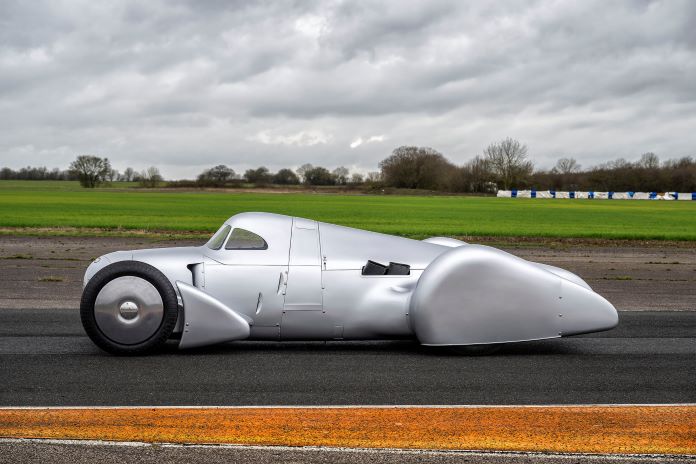
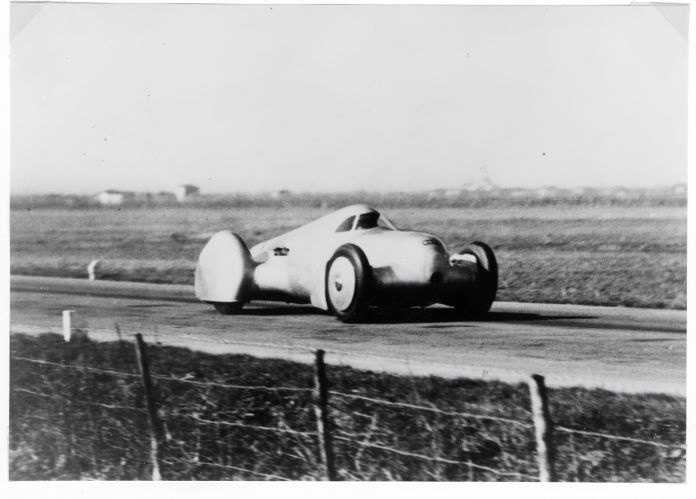
This car makes a statement: the Auto Union Lucca is emblematic of the technical innovation of the four rings in the 1930s. Audi Tradition has recreated the spectacular record-breaking car and will unveil it for the first time in early May in – aptly – the Italian city of Lucca. On February 15, 1935, the car set a widely acclaimed flying-start mile record on a straight section of the autostrada near Lucca, achieving a calculated average speed of 320.267 km/h and a measured top speed of 326.975 km/h. The Rennlimousine, a period term meaning “racing sedan”, was completed in the spring of 2026 and will join the legendary Silver Arrows in AUDI AG’s historic vehicle collection.
The 1930s see an international race to set records. Speed is far more than a mundane measurement – Grand Prix races and the constant breaking of speed records are followed and celebrated almost obsessively by the media and the public. Over the years, Germany becomes the scene of fierce competition among brands, drivers, and technologies: the star versus the four rings, Caracciola and von Brauchitsch versus Stuck and Rosemeyer, front engine versus mid-engine. Auto Union AG, founded in 1932 by a merger of Audi, DKW, Horch, and Wanderer, enters its first Grand Prix season under the new 750-kilogram formula in 1934 with the 295 PS Auto Union Type A. That same year, it leads the way in terms of speed records: Auto Union sets three world records on March 6 and five more on October 20 – all in a car driven by the experienced racing driver and hill climb specialist Hans Stuck.
Daimler-Benz AG is under pressure – and steps up its game: Rudolf Caracciola ties Stuck’s record and, in late October 1934, sets several international records on the highway near Gyón, Hungary, in a specially built record-attempt car. Among other records, he reaches an average speed of 316.592 km/h over a mile from a flying start. This is the speed to beat. The race engineers and mechanics at Auto Union are in for a “hot” winter. They are already planning the next record attempts for early 1935, so they need to level up their racing car. Based on the vehicle used to set the records in October, the experts first develop a wind tunnel model. This undergoes various tests – first as an open version, then with a closed cockpit for improved aerodynamics.
Auto Union’s racing division incorporates the findings from the wind tunnel at the Berlin-Adlershof Aeronautical Research Institute into the design of what will later become the record-breaking car – “a first in European racing car construction,” as the “Automobilrevue” noted at the time.
The body is finely sanded and coated with clear lacquer, and the spoked wheels are fitted with wheel covers. Two circular openings at the rear serve as fresh air intakes for the carburetor. The exhaust pipes point upward and are grouped into two outlets on each side. The car is already equipped with a 16-cylinder engine from the 1935 season, whose displacement has been increased to approximately 5 liters; however, this early version of the engine, with its 343 PS, does not quite reach the power output of 375 PS achieved later in 1935. The chassis and suspension are still those of the 1934 racing car, whereas the elongated, aerodynamic silhouette – with its fin-like rear end and teardrop-shaped wheel arches – clearly stands out from its racing counterparts of the previous season. At the same time, these changes – which are primarily technical and functional in nature – give rise to an aesthetic of speed that makes the Rennlimousine – as the press coins this high-speed car – one of a kind.
Record-breaking route: from Gyón in Hungary to Milan to Lucca
After just a few weeks of development work, the car in the workshop of Auto Union’s racing division in Zwickau is finished by December 1934. It is test-driven for the first time on Berlin’s Avus circuit on December 17, and at the end of January 1935, the decision is made: the record attempt will take place in Hungary – on the very same track near Gyón where Caracciola set the class record for a flying-start mile in a Mercedes the previous year. Auto Union makes all the necessary arrangements with the Hungarian Automobile Club; the high-performance record contender arrives in Budapest on February 4, 1935. The next day, the team sets off for the route about 40 kilometers further south; the weather is rapidly deteriorating. Nevertheless, two test runs are carried out on February 5. On the second run, the exhaust pipe burns through, and the tests have to be suspended. Due to the unpredictable weather, the race organizers decide to continue the record attempts south of Milan. But conditions are not ideal there either: the planned route is covered in snow, so Auto Union heads even further south. A suitable stretch is finally found on the Florence-Viareggio road between Pescia and Altopascio, near the city of Lucca.
This section of the autostrada is ideal for record attempts – level, with a high-grip surface, eight meters wide, and virtually straight as an arrow for around five kilometers. The first test drives begin on February 14, 1935. Various vehicle configurations are trialed, details such as the radiator grille and wheel covers are adjusted, data is analyzed. The next morning at 9 a.m., the car takes to the track near Lucca once again – with Hans Stuck at the wheel. Word has gotten around that something big might be in the works. “Automobilrevue” writes: “Auto Union’s new single-seater racing car, with its streamlined body made entirely of light metal, caused quite a stir among the many prominent figures from the world of Italian sports who had traveled to Lucca for the event. (…) Thousands of spectators watched the test runs.” Official timekeepers are also on hand: the independent chronometrists, as they are called at the time, use state-of-the-art chronometers equipped with electrically triggered photocells.