





The first two sessions of the Australian Grand Prix kicked off the real new Formula 1 season, with, obviously, the new regulations as protagonists. The Albert Park track is a complicated challenge in terms of energy recovery and this meant that we saw, from the first minutes, all the teams engaged on the track in the search for optimization not only of the aero-mechanical set-up, but also (or perhaps above all) of the battery discharge and recharging strategies to find the best compromise within the lap, especially from the point of view of the flying lap. The teams also seem to take for granted the significant difficulties in overtaking, given that almost everyone focused much more on optimizing the flying lap than on the race pace.
Ferrari starts well, Mercedes with limited laps?
In the first session the 1-2 Ferrari was not just the result of mere chance, but of an SF26 with a very centered set-up base. The rear appeared decidedly more stable than what we saw in Bahrain, and the two axles were always particularly balanced. The guidance of the pilots immediately benefited. On the one hand, a combative and fast Hamilton, who also allowed himself the luxury of a few long runs because he was confident enough to push to the limit, on the other, a Leclerc eager to lead, who asked the team for a further tight lap at the end of the session to regain the lead of the standings. During the first hour we also noticed quite different energy recovery techniques between the two standard bearers of the red: Hamilton showed a tendency towards small LiCos in the first sector, present but not particularly pronounced, while Leclerc seemed to prefer to collect all the moments of “sailing” while awaiting braking in a single point, the braking section of turn 11. RedBull also appeared competitive on the time trial in the first hour of free practice, but with what from the data appeared to be an inferior chassis quality to the Ferrari: the SF26 was in fact superior to its Austrian rival in all points where the aerodynamic load was fundamental, as well as in changes of direction which required stable and high-energy aerodynamics of the flows. The one who somehow seemed to hide a lot in the first hour was Mercedes, with Russell and Antonelli often tackling the long home straight with rotation speeds that were over 1000 rotations per minute lower than the competition. Even with them, McLaren didn’t seem particularly brilliant, especially from an engine-mechanical point of view (especially the gearbox). The impression was that the Brixworth Power Units still have some critical issues from a reliability point of view and that, therefore, Toto Wolff’s engineers use them at higher rpm only when strictly necessary to check settings and performance, but then, for the rest, they are content to reveal only a small part of the real potential. It doesn’t seem like a simple question of hiding it, but rather a necessity to preserve the driving units, at least in this first phase of the season.
In the second session Mercedes and McLaren emerged, while Ferrari couldn’t find the way
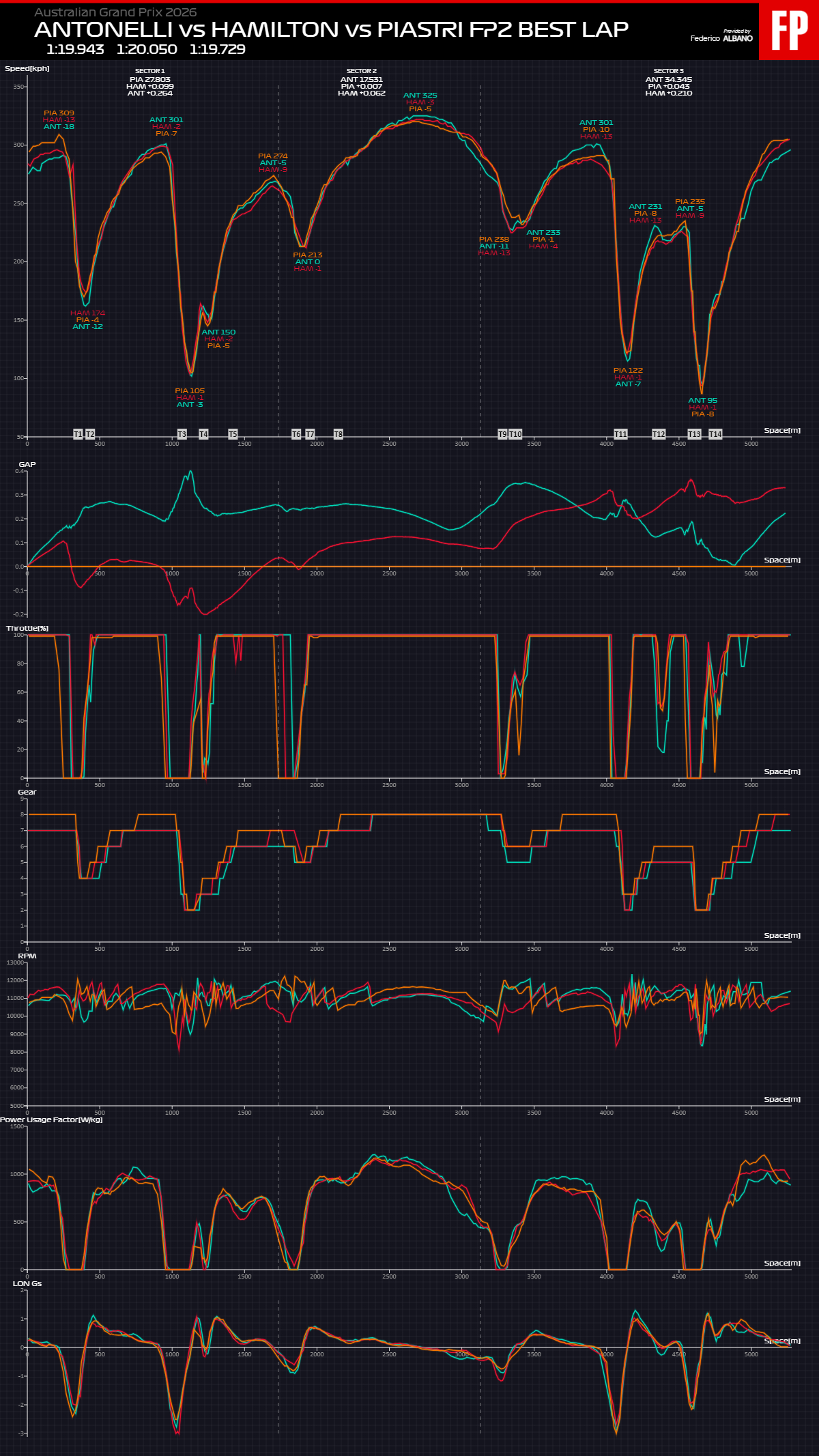
The situation in the second session was very different: Mercedes raised the level of power output and the resulting change of pace was evident. Russell and Antonelli give the idea that they definitely have the best package in their hands, both from a chassis point of view, with a single-seater that is simple to drive and with a high load level, and from an engine point of view, with a drive unit that appears powerful and flexible, capable of best managing the critical phases of energy recovery. In this context, Oscar Piastri also emerged with McLaren. If we compare the data of the top 3 teams we can notice something interesting.
Super traction McLaren
The energy distribution is clearly different between the three teams along the lap. McLaren started off strong, with the home driver reaching 309 km/h at the first braking point, even 13 km/h more than Hamilton and 18 more than Antonelli. One thing to note is that in the first sector Piastri especially does long lift and coast runs, at the braking points of turns 1, 3 and 6, losing relatively little, but then gaining significantly in the subsequent traction at the exit. It is a notable fact because it seems to underline a particular traction strength of the MCL40 also from a mechanical point of view, given that one of the main difficulties is being able to properly discharge the enormous torque provided by the hybrid to the ground when exiting corners.
Central phase in favor of Mercedes
In the very long back straight, however, Antonelli’s Mercedes prevails, with a more concentrated delivery which leads to a slightly higher and more concentrated maximum speed, followed by a long cut in power which ends up costing over 40 km/h of speed, as predicted by the analyzes on the eve. The conservation of energy at the end of the long stretch towards turn 9 then allows the Italian driver to have a greater reserve for the subsequent sprint up to turn 11, where Antonelli clearly prevails. In the last sector the Mercedes number 12 comes very close to taking the best time of the session, recovering over 3 tenths of a gap throughout the critical section for the tyres. A further confirmation of the innate qualities of the W22 also in terms of tire management, and therefore not only at Power Unit level. An unclean exit from the final corner by Antonelli and a slightly lower level of available power compared to the competition left Oscar Piastri leader of the session. It should also be noted that only Russell and Antonelli conducted a fairly complete long run simulation, showing a very high consistency of high performance which makes them absolute favorites for Sunday’s race.
Ferrari takes an unprofitable path, but Hamilton appears to have found himself
As far as the Maranello team is concerned, the data shows an overall delay, although with good ideas both in terms of engines and chassis. The impression is that on the one hand Vasseur’s men have chosen a less than perfect path for the evolution of the car set-up after the first session, on the other hand there is also a certain gap between the red team and Mercedes in particular, with the hopes of Leclerc and Hamilton focused more on fighting with the McLaren duo for second place, rather than really worrying Mercedes. It should be noted that Lewis Hamilton showed great driving brilliance and confidence, the likes of which we had perhaps never seen from him with the SF26 and this gives the idea of both a good fundamental car and a driver who, perhaps, finds the correct feeling for driving in these new cars and can therefore try to worry Leclerc.
Fundamental reliability node
We will therefore see how things evolve on the second day and, above all, in qualifying, the first real performance test of the season. Mercedes starts with the odds, but the reliability of the three-pointed star’s Power Unit could become a key point, not necessarily due to breakages, but due to the need to lower the power output to guarantee its longevity. Immediately behind there seems to be McLaren but with Ferrari that can try to worry the latter. Having said that, anything can really happen with these new single-seaters.