





We start with a complicated test
Now it’s a matter of hours and the new Formula 1 season will finally begin. The crucial issue to be resolved, in addition to clearly what the hierarchies will be on the track, remains that of understanding how much the top motorsport series can function and be attractive with the new regulations. The main point is, clearly, energy management and the Australian track located inside the splendid Albert Park in Melbourne is already a complicated test bed for the new drive units, let’s try to understand why with a simple representation. The underlying concept remains simple: braking zones and sections not traveled at full throttle are all opportunities to recharge the battery pack, which is then discharged when full power is delivered. A fundamental parameter therefore becomes that of understanding not only how full you are along the lap, but above all how long the stretches are in which you remain continuously with the throttle wide open.
Take a look at what we saw in Bahrain to understand the difference
We have therefore created a map showing the full stretches of the Sakhir track, where the tests took place, and of Melbourne, taking Lando Norris’s pole from last season as a reference for the latter. What emerges is immediately clear.
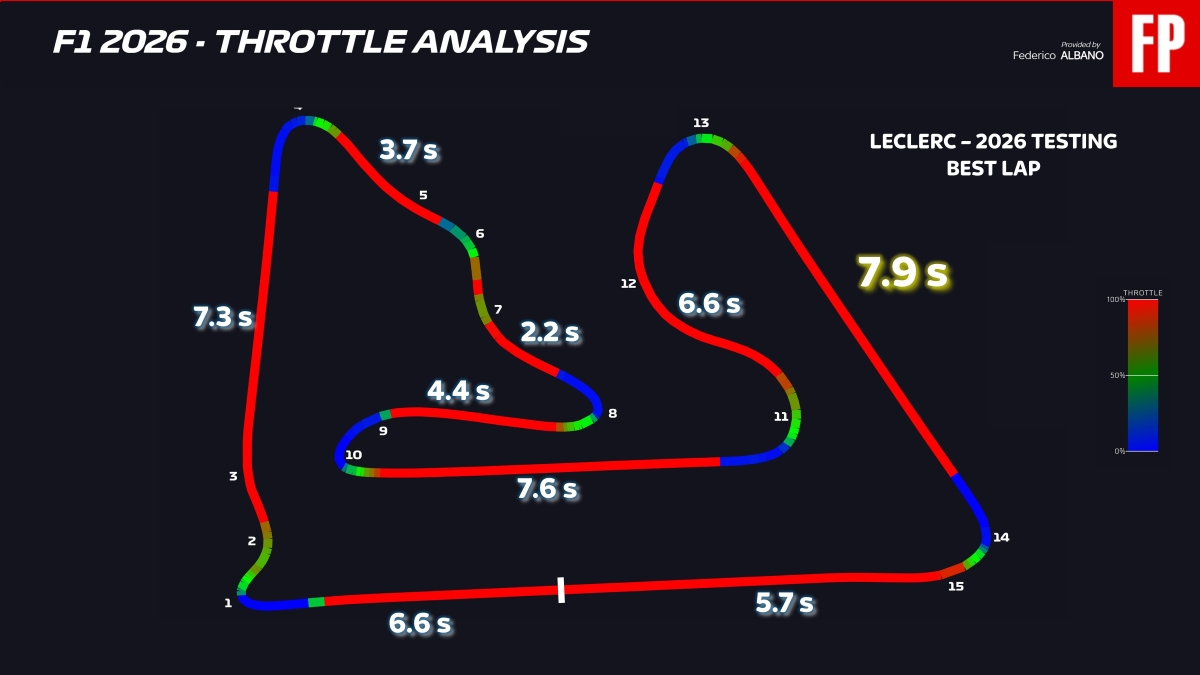
For Sakhir we considered the best lap of this year’s tests, that of Leclerc on the last day, but for lovers of precision we underline that we also checked with Piastri’s pole lap of 2025 and found no substantial differences. The approach is clear: many sections covered at full speed (considering an accelerator above 95% as full speed) but continuously interspersed with braking or guided sections (such as the “snake” of the second sector). The result is that the longest continuous stretch covered at full speed is the descent leading to the braking section of turn 14, with 7.9 seconds covered with the throttle wide open. It should also be underlined that the two sections on the main straight (before and after the finish line) clearly should not be added on the flying lap, but it helps to understand why during the tests the drivers did not already exit the final corner with the throttle wide open but waited until a few meters before the finish line to accelerate: they were trying to minimize the discharge time in that section of the track.
Melbourne is very different
If we now consider, however, what happens in Melbourne we notice first of all that the sections in full cover a larger portion of the track than in Bahrain, given that from the calculations it appears to be approximately 10% higher.
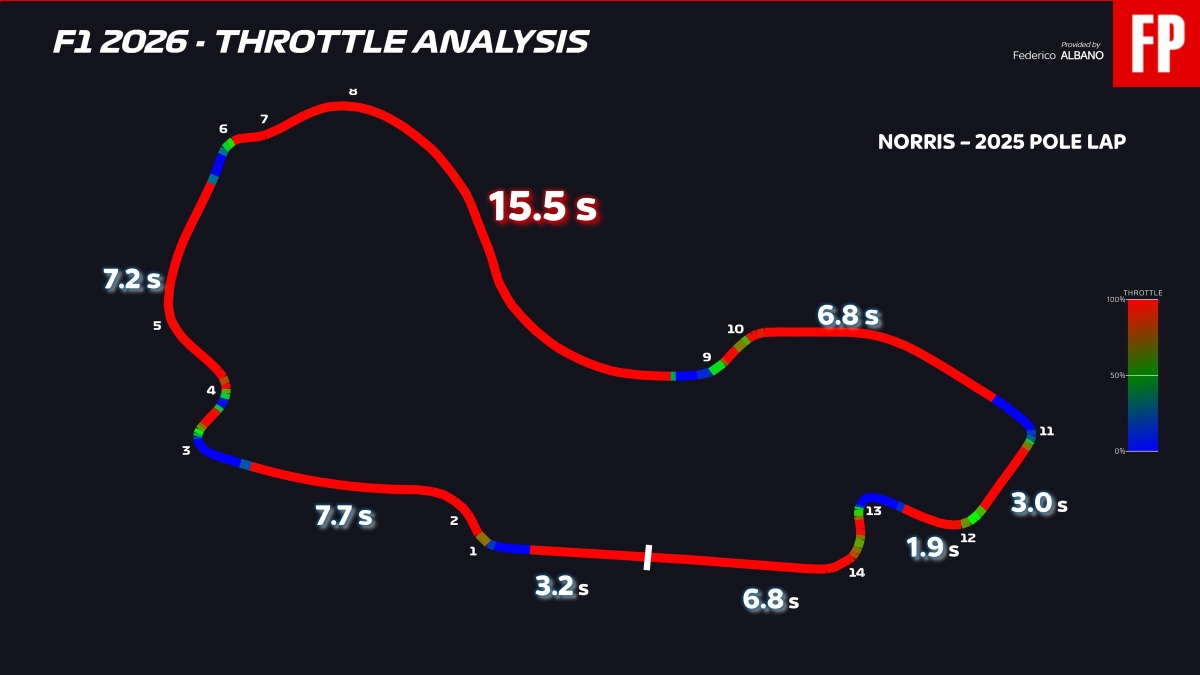
But above all we note that the very long stretch that goes from the exit of Turn 8 to the rapid chicane of Turns 9 and 10 is approximately twice as long in terms of time compared to what happened at Sakhir, meaning the drivers have to stay with the throttle wide open for around 15.5 seconds. Furthermore, the passage of the change of direction of turns 9 and 10 is at high speed, in fact not a real braking, and therefore offers a very limited opportunity to recharge the battery. Immediately afterwards there is a further 6.8 second acceleration before a real braking section, that of turn 11, which finally allows you to take advantage of the regenerative braking to “fill up” with energy. It is clear that in this very long stretch, fully traveled, the 4 Mega Joules of usable battery will be consumed entirely by the single-seaters, and the drivers will find themselves having to manage the speed in a straight line with the power of the combustion engine alone.
Super clipping, clipping “on steroids”
For this reason we will talk about “super clipping”, which is nothing other than the clipping that has always been there since the introduction of the Power Units, but so evident as to deserve the nickname “super”, with a loss of speed in a straight line between the moment of maximum speed and that of braking at the end of the acceleration of up to 40 km/h according to some teams. The debut therefore risks immediately exposing the critical issues of the new regulations and all eyes will be on the second sector to understand what the engineers and drivers will invent to manage such a long continuous stretch.